


I. Introduction
II. Methodology
III. Analysis
1. Socio-Economic impact
2. Land and housing appreciation
3. Economic diversification
4. Industrial growth and shift
5. Spatial changes
6. Changes in travel patterns
7. Population influx and impact on surrounding cities
8. Station's influence area (SIA) and key factors while planning
9. Visualising a bibliometric network
IV. Discussion
V. Conclusion
I. Introduction
The shift in connectivity has led to a transformative change in the process of urbanisation. It has greatly affected how larger regions interact with smaller regions and vice versa. This shift can be observed in rail-based transport as well. Especially, the spatial and temporal impact of HSR around the world on the urban regions has restructured development in different directions. This impact can be as direct (multiplier effect), indirect (spill over effect) and substitution, where it all aims to have a regional population agglomeration effect (하미란・진장익, 2024). Alongside, it promotes regional economic and industrial development. Thus, it gives rise to the ripple effect due to an increase in the demand for the infrastructure and a transport model shift. Particularly in the case of the High-speed railway (HSR), it affects the regional socio-economics due to a shift in the use of highways and impacts the regional development depending upon the distribution of the spatial resources concerning the distance from the station periphery to the city centre. Due to the demographic shift, investment, technological advancement and knowledge spill over within cities uplift the urban innovation. The proliferation of high-speed railways across Europe, Asia and America was a strategic investment transcending mere transportation efficiency.
Japan’s Shinkansen was the first HSR in the world, operating between Tokyo and Shin-Osaka from 1964. Subsequently, Italy, France, and Germany followed Japan’s lead in HSR-based development. Each country has been shaped differently due to various regional factors and has its challenges. e.g., Japan Shinkansen is globally known for the impact it has created in generating employment and economic activities along the railway network (Wang et al., 2018). However, later it suffered regional imbalance (Kobayashi and Okumura, 1997).
In the case of South Korea, out of various reasons to introduce the HSR, one of the major outcome expectations was to solve the population concentration within the major cities. With the expectation of directing the population dispersion towards the mid-sized and small- sized cities. However, the results were distinct from expectations; the concentration of population and economic activities in larger urban areas intensified after the introduction of KTX (Jun and Lee, 2007). However, in some region’s studies have observed mixed urbanisation impacts. Contribution towards the regional divergence in GRDP and population distribution shows beta- convergence, which means faster growth of economically poorer regions than rich ones, in the case of employment-affected urbanisation pattern along the Gyeongbu- line (Jo and Woo, 2018). Iksan city has experienced revitalisation in the old market centre due to its proximity to the station’s periphery. Moreover, there are cities which have experienced an increase in tourism and employment in the service-based industry.
High-speed railways in Korea not only changed regional accessibility but also brought economic growth in connected cities, new urban expansion and development around station areas, decentralising population concentration and led to the relocation of public institutions. However, none of the previous studies claim an overall positive effect. Since it also had negative impacts, such as a population shift from small regions to megacities and uneven development in the nearby cities, which are not connected to the KTX corridor.
Overall, HSR brought multifaceted changes within a region and its surrounding regions. Therefore, it demands the need to be studied comprehensively. Therefore, this study aims to provide a comprehensive overview of the impact of HSR through a systematic literature review. Through identifying the change afterwards, the introduction of HSR in the urban and suburban regions, focusing on Honam and Gyeongbu line region-based cities. Alongside synthesising the international cases for each subsection. Focusing on the following direction: Shifts or changes in the socioeconomics of an area and its reasons for change based on the previous findings. Intensity of spatial and demographic polarisation and its reasons. And how does the introduction of HSR in South Korea, aimed at reducing regional economic disparity, population concentration, and encouraging economic growth, change the local manufacturing and service- based industry?
II. Methodology
The Systematic Literature Review (SLR) has been conducted following the guide developed by PRISMA (2020). For this study, the literature search was conducted via relevant keywords through a structured approach. The source was taken from the complete database of Web of sci, Scopus and KCI. The search query for Scopus and Web of sci is as follows, respectively.
(TITLE-ABS (KTX* OR Korean AND high AND speed AND rail* OR KTX AND high-speed AND train* OR Korea AND train AND express*) AND (economic AND growth* OR city AND development* OR socioeconomic AND changes*) AND (spatial AND changes* OR demography*) AND (urban AND polarisation* OR spill over AND effect*)
TS= ("High-speed rail" OR “KTX” OR "Korea train express" OR "high-speed train") AND TS= ("Impact of Korean train express") AND PY= (2004-2024) AND (LA=(English) OR LA=(Korean)) AND TS= ("spatial change" OR "demographic change" OR "spill over effect" OR "urban expansion")
Also, the KCI database has been searched by city names. Furthermore, the search was narrowed down based on the inclusion and exclusion criteria, which are as follows. Inclusion criteria- Studies published in English and Korean, Studies focusing on HSR impact, Papers published within the last 20 years and Research covering cities or regions with operational Honam and Gyeongbu HSR lines. Exclusion Criteria- sources (e.g., blogs, opinion pieces, Studies not related to HSR and Articles not providing empirical evidence.
The screening process has been done in three stages (Figure 1). In the first stage, the general keyword search is applied. In the second stage, we applied the research area limitation and manually scrutinised the relevance through the title of the study. In the third stage, abstract screening was conducted. Out of 23 studies, two studies are taken as the base for the generalised perception around HSR and other studies are considered for the systematic literature review to highlight the previous research’s results.
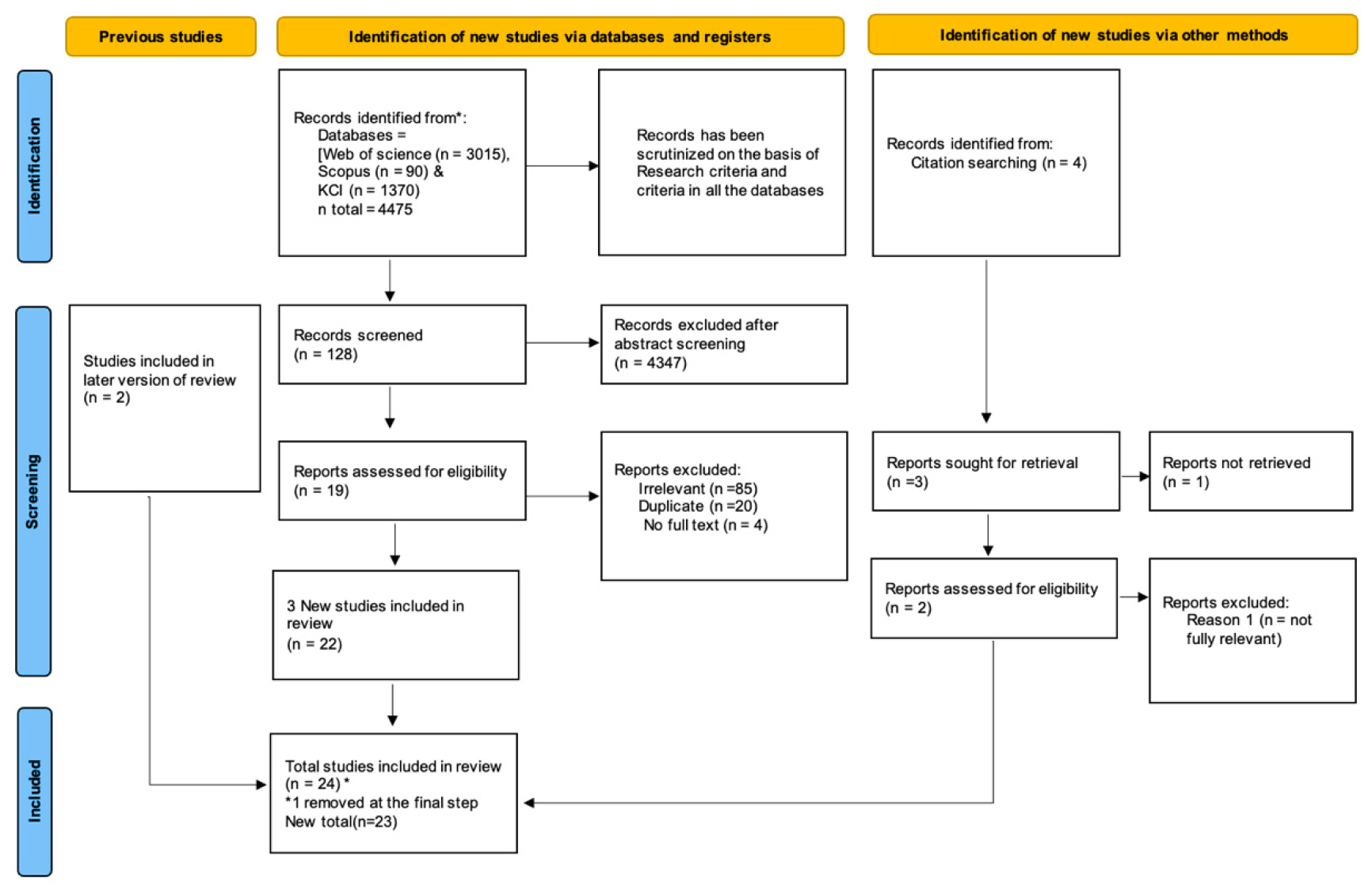
In addition, a synthesis of international studies has been specified at the end of each theme to emphasise the summary at an international scale.
III. Analysis
The development of high-speed railways is essential for national and regional level development and policy making (양철수, 2015). Primarily, it improves the economy, followed by the ripple effect that creates overall difference through multifaceted phenomena, such as direct investment, employment, innovation and demographic change within a region and in the neighbouring regions (regional industrial and cultural exchanges). HSR in South Korea has also changed the space and time landscape to a varying degree; now it is referred to as a half-day living area. However, this change led to both positive and negative impacts on the surrounding regions. Especially regions that are not integrated with HSR or have proper HSR-oriented transit systems. In such cases, local resources become concentrated within the big cities, resulting in the “straw effect”. Therefore, the following sections aim to look into the detailed literature based on the impact left by the KTX on various urbanising factors. While the central discussion of this study remains KTX-based, a brief synthesis of international cases has been provided to contextualise the findings. Firstly, in-depth literature on KTX has been analysed, followed by a subsequent concise comparison with international HSR implementations to highlight the similarities and differences.
1. Socio-Economic impact
KTX opening has left various economic effects, i.e., economic growth, production share, catalyse investment, new development areas and a revitalised real estate market in various regions. In addition, certain policies placed emphasis on the specialised development around the HSR stations per the idea of change in use of national space, such as ‘KTX economic zone’ (Jangik and Lan, 2024). However, there are various factors included in making HSR-based development successful. Such as in the case of Ulsan city, the impact of the KTX did not result in balanced development due to the ongoing industrial crisis. While spotting the influence in the Daegu region, observed the shift in the regional consumption growth (increase in the department store indexes in areas served by the KTX) (Park and Kim, 2016). Significantly, in Seoul, Daejeon and Busan, medical care trends (increase in medical care service in Busan), economic spill-over (production and employment growth) through construction investment and demand substitution among different transportation modes.
HSR provided faster access to the metropolitan cities, leaving a negative impact on the smaller regions around these cities. It drains the economic activities by intensifying the regional disparity, which only favours the larger cities (Givoni, 2006). Thus, weakening the influx of the public towards smaller regions. Similar phenomena have been observed (Lee et al., 2024) in Busan and Ulsan. Whereas it also leads to resource allocation within a region, which results in regional disparities within the city. It indicates that a buoyant local economy is required for a positive outcome. However, in the case of Ulsan, it brought resource relocation within the city, centring on service industries when there was a massive shift in the service-based industry (이승훈 등, 2024).
Moving from the socio-economic impact of the KTX case to the global context, Japan has noted large welfare effects alongside the significant results in local employment, an increase in rent and wages (Koster et al., 2023). In Germany (Neubaustrecke Köln-Rhein/Main), an increase in GDP was noted at 8.5% (EY, 2023) alongside the regions on the Neubaustrecke Köln-Rhein HSR line. It was the result of Labour mobility, market integration, Marshallian externalities, productivity and exploration effect. However, there is a contrast in the results that has been seen. Cities served by HSR have observed a boost in socio-economic conditions (Ahlfeldt and Feddersen, 2018), intermediate and peripheral regions have noted a negative impact through cost-benefit analysis (Cheng et al., 2015). However, these studies have their limitations due to the chosen methodology, which limits them from a few analytical points. Moreover, need for comparative studies at the domestic and international level for micro-level analysis and policy-sensitive evaluation.
2. Land and housing appreciation
Accessibility significantly changes land use and spatial structure around the station area, leading to a shift in land prices. KTX introduction in the smaller regions has led the appealing changes in the land and housing prices. To analyse changes in land value (임지훈 등, 2013), analysed the correlation between land price changes and variables such as land use and traffic density through multiple regression analysis, which shows that the rate of change was highest in the Gyeryong station area, followed by Iksan, Miryang, and Mokpo stations. Gyeryong and Miryang, being smaller cities, experienced relatively larger changes in land prices compared to Mokpo and Iksan. Distance to bus stops, adjacent roads, and the width of adjacent roads were found to be significant factors. In larger areas, factors like lane distance and maximum gross floor area to the railway station were influential, such as in Iksan and Mokpo. In smaller cities like Gyeryong, proximity to bus routes and adjacent roads was less impactful. Significant differences in land value changes were observed before and after the HSR opening.
The geographical isolation of the stations from the main urban centres limited the broader stimulation of the real estate market. The regression analysis (조재욱・우명제, 2014)observed that the overall impact on housing prices and trading volumes in the station areas was minimal. The data indicate that while specific areas experienced growth, the overall housing market did not see substantial changes directly attributable to the KTX. Yeosu Expo and Changwon Central Station have experienced substantial rises in land prices and trading volumes. Housing prices around KTX stations have also exhibited marked increases. Busan Station and Shinju Station, in particular, saw a rise in housing prices and trading volumes (Kim et al., 2016). The hypothesis testing (강병길・강정규, 2018) shows year-by-year significant land fluctuation at different levels: 10% in 2010, 5% in 2014, and 1% the rest of the years.
The Increase in rate of land price in the Bunseok target area has gradually increased since 2010, and has risen significantly in the two years after its opening. Later shows a downward trend in 2013 upward trend in 2014. It declined until 2015 and was flat in 2016, but the Ulsan City rate increased again in 2017, Gimcheon City was flat, and Gyeongju City showed a three-year downward trend. The overall average annual growth rate was 11.33% for Ulsan Station, 5.87% for Gimcheon (Gumi) Station, and 5.23% for Shin Kyung Ju Station. In addition, the overall increase rate from 2009 to 2017 shows that Ulsan Station was 90.72%, Gimcheongu Station was 46.27%, and Shin Kyung Ju Station was 41.87%. Another study also observed a similar pattern around Gyeongbu High-Speed Railway Station, revealing variations based on station characteristics and individual land characteristics (He and Jin, 2024). Different stations show different rates of land change, influenced by their specific attributes and surroundings. Most of the studies revolved around the price hike and indicate that there is a gap in research for shifting land prices in the region, which are far from the axis of the primary city. Which needs to be explored.
Building an insight from an increase in the rate of land prices from the KTX context provides an overview of the constant changes in the value. While international cases provide more socioeconomic disparities. HSR in Vietnam limits access to only the high-income group, leading to social inequality rather than public transport accessibility (Ngoc and Nishiuchi, 2022). Moreover, an interesting pattern has been noted in Japan, where Shinkansen led to urban decentralisation and a decrease in land prices, making it more affordable (Nickelsburg et al., 2020). However, most of the KTX-based research revolves around analysing the impact on the urban region, and lacks the focus on smaller or peripheral regions, highlighting the need for studies on the decreasing value of land and housing in peripheral regions.
3. Economic diversification
High-speed railways generate a multiplier effect directly and indirectly along the line. While looking at such an effect, the influence right after the operation of KTX on Gwangju Songjeong railway station influenced the area on the Honam line (Jeong, 2015), and observed an increase in economic diversification. Which notes 28.2% increase in passengers between Chungbuk Osong and Gwangju-Songjeong district, increased utilization rate of Jeonnam National University Hospital, 8.4% increase in the tourist visiting the region in comparison to the previous year (Gwangju Metropolitan City, 2015b), sales during April to June 2015 of distribution industry increased a little compared to the same period during previous year, increase in local demand caused the reduction of domestic air and high-speed buses. On the other hand, a negative impact has been observed in the case of the Ulsan region; there is a significant reduction in GDP share in gross national product after the opening of KTX (4.6% in 2010 to 3.6% in 2020) due to the impact on business composition. A similar observation has been concluded (조재욱・우명제, 2014). Before the KTX's introduction, the Gyeongnam region's share in the nation's total production was stable. However, after the KTX commenced operations, Gyeongnam's share declined from 16.4% in 2010 to 14.0% in 2020. Convertsely, the metropolitan area's production shares grew significantly, from 45.3% to 52.7%, during the same period. A study of 104 regions shows an increase in average GDP; nevertheless, deepened regional economic imbalance has also been indicated in regions like Dongducheon.
Moreover, the results in the case of international studies are at the micro scale. South Europe Atlantic high-speed rail, France, estimated 14,000 jobs created through the input-output model combined with the fieldwork (Blanquart and Koning, 2017). On the Cologne–Frankfurt HSR line elasticity of local productivity increases by 3.8%, found using the micro data and mitigating the issue of reverse causality (Melo et al., 2009). In Spain and China, these results have been favourable to the tourism industry. Spain observed a boost in local business due to more tourist traffic (Feliu, 2012) and in China, the tourist traffic increased by 20% and revenue increased by 25% (Chen and Haynes, 2012). However, not the same in the case of other nations. Such as Italy and Vietnam lack studies which further explore economic diversification. Rather than simply focusing on the connectivity, it needs to be adequately planned with other factors such as potential growth for the local market, aligning it with the ease of access for daily commuters and locals and existing regeneration plans.
4. Industrial growth and shift
In general, HSR had a significant impact on manufacturing-based cities from the evidence of previous studies, since it has a spill-over effect between major cities, cores and peripheral (Fang et al., 2020; Zhou and Zhang, 2021). Also, the shift is mainly from the primary and secondary to towards tertiary industry sector (Hu and Xu, 2022).
In the case of KTX, the expected results from such cities were mostly positive (Yao et al., 2023). To test the hypothesis, analyse the effectiveness of KTX on the Ulsan, Pohang and Gyeongju regions using the synthetic control method (정일홍・이성우, 2011). Finds that there are local factors as well that affect the industrial composition besides KTX. Such as Ulsan's shipbuilding industry. Major changes in Ulsan were the shift in resource relocation within the city, alongside the shift in the food and accommodation industry had a positive impact. An increase in non-manufacturing employment and a decrease in manufacturing employment have also been noted. Pohang shows a slow growth rate in service industry employment compared to the control group, consistent with the "straw effect," where service consumption shifts to larger cities. Gyeongju also went through a slowdown in service industry employment growth, contrary to expectations that KTX would boost local tourism and service employment.
To qualitatively examine the supply chain structure of economic activities to analyse the impact of the KTX sector on other industries (Park and Sang, 2015).
The study concludes that while selecting sectors for regional development within national strategic interest, manufacturing-based development strategies were effective. Major findings point out that core industries are linked to the KTX sector, enhancing network centrality and connectivity.
Ulsan is one of the largest industrial cities, and half of it is composed of manufacturing-based industry. Therefore, it was difficult to find any significant impact since KTX is not a freight train. Moreover, further results note a decrease in service industry employment rate in Pohang and Gyeongju (Lee et al., 2024). However, significant changes in land use and business development have been observed, particularly focused on the HSR station periphery in Dong-daegu (Eom et al., 2020). Expansion of wholesale, retail, accommodation, and financial sectors indicates driving social and economic activities. Also, projects completion of the shopping mall and transfer centre is projected to further boost the growth (Kim and Kim, 2016).
Interestingly, the industrial shift follows a different pattern across multinational cases. European cities show industrial convergence, on the other hand. Chinese cities show the increasing divergence, which reflects the governance and economic maturity and reveals divergent regional economic trajectories (Cheng et al., 2015). Thus, the regional industrial shift and shift in economic geography can be further explored with the microeconomic data (employment rate), sector-specific studies and aligning these with the social network analysis at the national and international levels.
5. Spatial changes
Evidently change in the spatial structure of a city is one of the most notable changes after the introduction of high-speed railway. HSR impact the urban scale through the space and time convergence effect (Wang et al., 2020). This compression by the HSR improves socioeconomic conditions of a region owing to a decrease in travel time and improved connections. These changes often led to a new spatial economic landscape (Givoni, 2006). Thus, the overall impact of land use and land cover around the station periphery has been observed to show a positive trend. Moreover, revitalisation of old city centres in the old and smaller cities (Daejeon and Iksan) took place under the regeneration of rail station areas (이병대・심재승, 2013). An observational variable analysis revealed the significant spatial changes between 2000-2010 in the Dong-Daegu station area due to a shift in the population (Kim and Kim, 2016). On the other hand, the impact on the farther regions has been generally observed as negative due to the accessibility inequalities (Vickerman et al., 1999). Unequal accessibility and regional disparity increased significantly (12.19%) in the non-capital regions without the HSR (Kim and Kim, 2020). In juxtaposition, mid-sized cities get the most benefit, and small-sized cities are affected severely.
Regions do not follow the identical spatial pattern of change. It varies according to urban forms, economic context, traditional approaches and policy framework both at the national and international level.
While looking at the international cases, Japan and China show a heterogeneous change at the micro level (Liu et al., 2024). On the other hand, European cities mainly follow the following patterns: CBD, peripheral development and edge city formation (ADBI, 2019). And interestingly, Vietnam follows a similar pattern of development, which has been followed by the mature HSR networks around the world.
Based on the previous studies about spatial changes, the adoption of spatial equilibrium models combined with socioeconomic and data of LULC changes to explore the impact in a heterogeneous local spatial context appears to be a necessary consideration.
6. Changes in travel patterns
The social impact of the HSR around the world and in Korea is very complex (Figure 2). The direct effect of transportation shifts the modal share, traffic volumes and travel patterns (Givoni, 2006). It sets a social order over time. Looking at research in the KTX context on the commuters through Daejeon, it’s clear that the sole reason for choosing the KTX is not only to save time but also safety, comfort and punctuality alongside the conventional reasons (Ji and Lee, 2016). KTX significantly impacted each city differently. In Seoul, it increased the mobile population on weekdays, mainly attracting people from Jeong-eup and Mokpo, with access distances ranging from 10-25 km. Iksan observed an increase in weekday mobility within 150 km but decreased beyond 200 km, with access distances of 20-25 km, and more hotspots and compactness post-HSR. Jeong-eup experienc ed increased weekday mobility within 150 km, fewer travellers from Seoul, and access distances expanded to 15-20 km, with slightly higher compactness and hotspots farther from the station. Mokpo displayed increased mobility at all distances, with positive effects on both short and long-distance travel access within 20 km. The highest compactness increase (50%) and more hotspots post-HSR production in the region. Overall, the studies show HSR had a positive impact on all cities with increased mobile populations, more hotspots and higher compactness. Also, these effects varied depending on the distance from Seoul and the size of the city (Eom et al., 2020). However, HSR is not sufficient to drive growth; therefore, a strategic plan is needed to capitalise on the new infrastructure. Development approach for station areas requires a multi-faceted perspective, addressing more than just physical aspects (이병대・심재승, 2013).
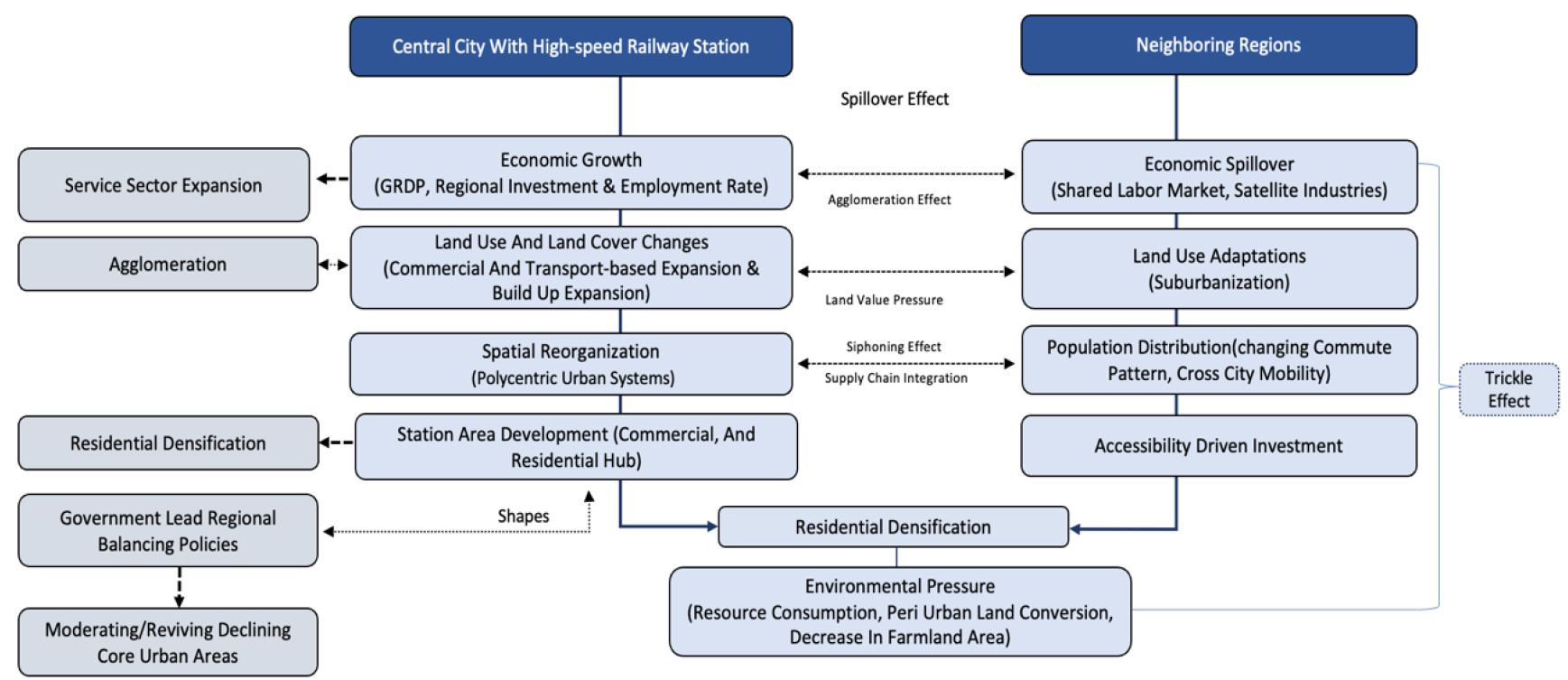
Identically majority of international HSR systems noted similar patterns (Desmaris, 2016.; Heuermann et al., 2018; Le et al., 2018; Ngoc and Ngoc, 2022; Yamaguchi, 2017). However, the drawback of the commute behaviour which needs to be studied is the long-term travel behaviour pattern, aligning it with access to all the socio-economic classes at the multi-city domestic level.
7. Population influx and impact on surrounding cities
Population influx significantly increases after the introduction of HSR (Hiramatsu, 2023; Wang et al., 2019). Commonly, movement is observed in the metropolitan areas experiencing economic growth and population influx, while the smallest cities face decline. To abate this, the government introduced various decentralisation policies from 2003 to 2010, and these policies were somewhat effective with the plan to decrease the concentration of population in megacities and enhance reasonable development.
Therefore, KTX has been introduced. However, KTX has intensified the concentration in the metropolitan cities (Kim and Kim, 2022). Moreover, to support this fact, population change predictions from the above study show that there has been an increase in population in the Seoul metropolitan area, including Incheon and Gyeonggi. However, regions like Gangwon have noted a decrease in the population. This study observed a different reason; according to the study, newer SRT stations are more influential in promoting population growth than KTX. However, the supporting reasons for such a change are unclear and yet to be explored fully.
High-speed rail performs the function of alleviating population concentration in the metropolitan area (Kim and Kim, 2022).The studies claiming a shift in population after the HSR introduction show different temporal results. An analytical study analyses the impact of population shift after opening the KTX from 2004-2009 (Il Hong Chung and Seong Woo Lee, 2011). The main findings state that KTX acted as an influx factor in the initial stage and led to the inflow of 534 people when the access was improved by 1%; however, after five years, the outflow of 301 people led to population drain from Kyungnam and Kyungbuk. Overall, the introduction of KTX initially played a positive role as the axis of national development by absorbing population from the regions of poor accessibility, but its role has been reduced over time (Jung and Lee, 2011). Also, a significant outflow by KTX from the Kyungnam and Kyungbuk regions and d influx into the Seoul Metropolitan and Chungcheong regions may indicate that KTX has not solved the problem of congestion in the Seoul Metropolitan area, which was estimated at an initial phase. Moreover, Jung and Lee (2011) claimed that there was a population leakage effect mainly in the Gyeongnam and Gyeongbuk regions after the opening of KTX. Ulsan went through dynamic population changes; however, these changes are not constant and positive (Lee et al., 2024). In the initial stage, it attracted a younger population (for living and commuting), but later on, the isolation of the station from the city centre didn’t lead to the potential straw effect. Not only positive but negative impacts have also been experienced by metropolitan cities post-KTX opening; the area indicated that only specific areas remained hotspots, primarily within a 2km radius of the station in Daegu (Kim and Kim, 2016).
On the other hand, some regions experienced a relatively stable population distribution. The overall trend in certain areas has been observed as declining. A study done on regions like Yangju City saw a significant increase in the population per 1,000 people (조재욱・우명제, 2014).
HSR connectivity attracted population closer to the KTX stations, leading to a regional imbalance in surrounding regions like Gwangmyeong station. This region has noted growth in the economy and increased area uses (Kim et al., 2016). To examine the effect of KTX station opening on population, Jangik and Lan (2024, conducted a study using the difference in difference method. The study does analyse the impact of KTX on cities with KTX, with the cities where there is no KTX (or will open in future). Findings show that there is no overall direct impact on population change. However, its influence varied between metropolitan and non-metropolitan cities, with a slight population decrease in metropolitan areas, with no significant change in non-metropolitan areas.
Internationally, studies on the population change due to the HSR have been conducted comparatively in depth. A study in Japan found that using PSM-DID with a 1km grid shinkansen led population siphoning effect and depopulated some areas and effects beyond the administrative boundary (Wang et al., 2024). The balance of agglomeration and dispersion leads to optimal spatial radii changes. These patterns are mainly characterised as population shift followed by economic shift or vice versa.
8. Station's influence area (SIA) and key factors while planning
Urban planning and transportation systems are required to adapt to changes centred on public transportation, to analyse urban development strategies around the station area.
While looking at the impact of KTX, in the case of Gwangju-Songjeong station, the dependence on Gwangju city increases dependence on highly concentrated tertiary industries and decreases the relation of time with distance (Zheng and Rho, 2015). However, accessibility also decreases the dependence of the smaller regions connected with Gwangju and shifts the dependence towards other accessible regions.
Overall, 43% of KTX stations are in city centres, while 57% of KTX stations have lower accessibility from the city centres (Kim et al., 2018), which also shows the decreased passenger relation with the distance. Also, stations such as Osong, Gimcheon (Gumi), Shin-- Gyeongju, and Ulsan are located on the previously constructed dedicated HSR lines, these stations were in intermediate zones (e.g., targeted in small and medium- sized cities) away from urban areas therefore, had less negotiation power when the line was designed and influenced the accessibility from the main city centre (Vickerman, 2015). However, HSR is very likely to cause urban expansion and polycentricity (Gong and Li, 2022). Whereas in regard to South Korea majority it intensified the regional imbalance. Therefore, station proximity to central business districts is an important consideration for locating future KTX stations in either mid-size cities or suburban areas to maximise the economic impacts of KTX services.
Key recommendations incorporate maximising land use efficiency through high-density complex development, expanding transportation networks, integrating urban planning to improve central functions, and legal and institutional flexibility. Since, depending on the spatial scale and population density effect of the HSR network has been more intensive (Wang et al., 2022), and the vitality of urban activities around stations depends on their spatial context (Kim et al., 2018). For example, KTX stations that followed the location strategy of the conventional railway city centres performed better, alongside promoting regional economic development and industrial agglomeration (Xu and Li, 2023) and expedited the integration of economic resources between regions and promoting economic development, industrial agglomeration, and enterprise efficiency.
International studies also focus on the changes led by distance from the SIA. However, there is a lack of studies on the quantitative evaluation of businesses in the SIA. Suggesting the need for station-based SIA metrics, real-time mobility data and urban planning models for future studies.
9. Visualising a bibliometric network
Visualisation is done using VOS Viewer to understand the relation between all the keywords in the 23 studies which have been included in this SLR. These keywords are connected by the nodes, which represent the strength and frequency of the co-occurrence. Moreover, the temporal focus of the studies has also been represented (Figure 3).
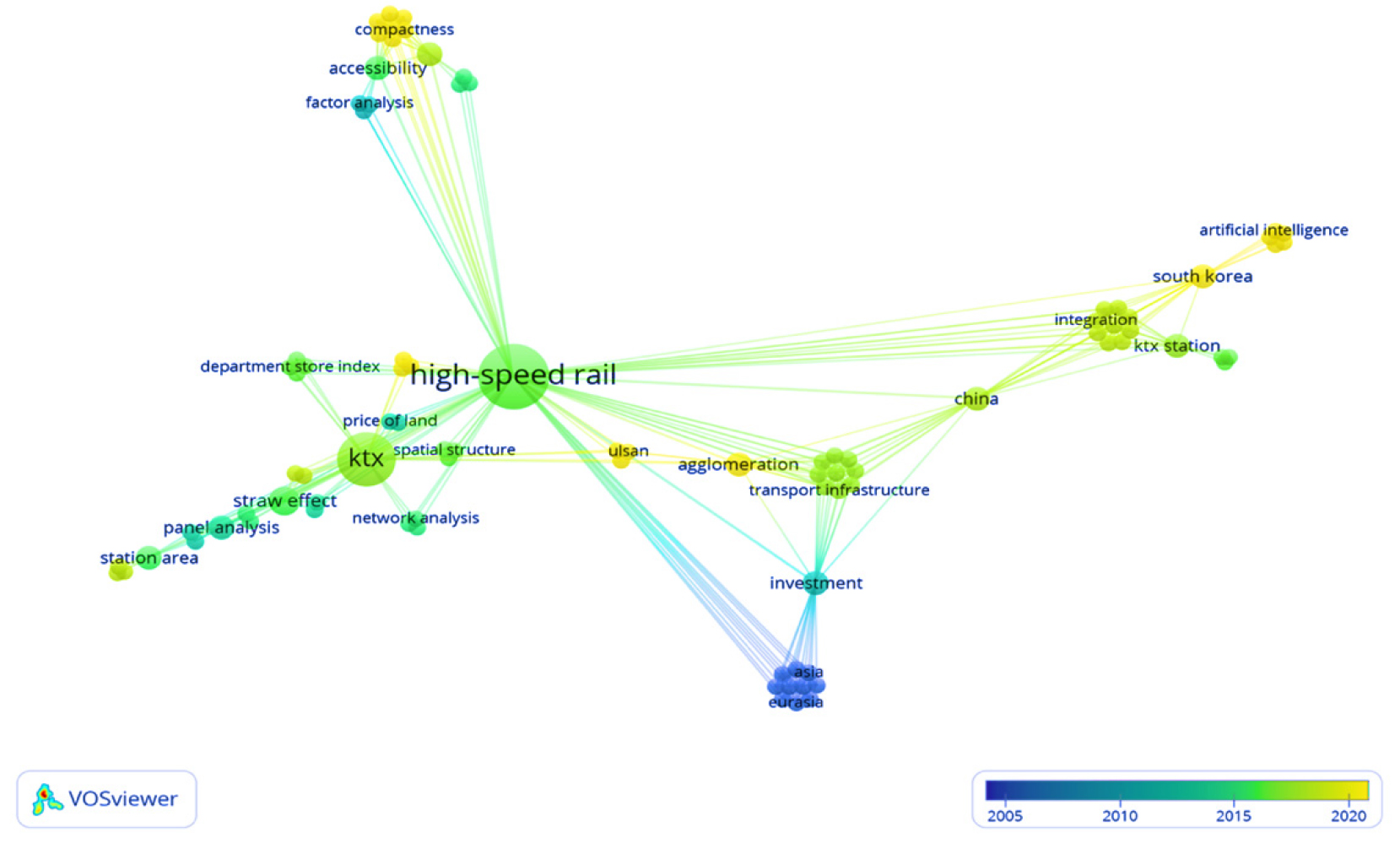
Newer topics include compactness, accessibility, employment, spatial inequality, mobile phone data, Population change, AI, local cities, regional economy and regional extinction. The older topics cover the population distribution and the changes in land prices (Table 1).
Table 1.
An overview of the study included in this literature review of KTX lines
| S.no | Author & Year | Title | Period | Study Area | Method | Findings/Suggestions |
| 1 | Givoni, 2006 | Development and Impact of the Modern High‐speed Train: A Review | - | Countries with HSR infrastructure. | Qualitative study | Summarises the positive aspects of the HSR and justification for the HSR infrastructure, and the economic relations |
| 2 | Jung and Lee, 2011 | The Effects of KTX on Population Distribution between 2004 and 2009 | 2004-2009 | All the regions | Analytical modal | The impact is unclear due to the local industries' effect on social and economic changes. And suggest the impact of KTX might lead to industrial stagnation in small cities due to this shift in population towards the largest cities. |
| 3 | 임지훈 등, 2013 | An Analysis of the Impact Factors Affecting KTX Station Areas | 2012 | 4 stations | Focus Group Interview & Regression Analysis | Highlight the need for urban planning and land management for comprehensive station edit development plans. |
| 4 | 이병대・심재승, 2013 | A Study on the Revitalisation of the Old City-Centre in Local Cities: Focusing on the Regeneration of Rail Station Areas | - | Daejeon and Iksan | Review and analytical framework | Focuses on the city image and complex development, alongside focusing on the non-physical centres such as finance and taxes, to revitalise and seek changes in the station area. |
| 5 | 조재욱・우명제, 2014 | The impacts of high-speed rail on regional economy and balanced development: Focused on Gyeongbu and Gyeongjeon lines of Korea Train Express (KTX) | 2003-2010 | All the regions of Gyeongbu and Gyeongjeon line (23 stations/6 Major cities, 55 cities and 43county) | Regression analysis | Deepen the regional imbalance in gross production and population in the region. |
| 6 | Jeong, 2015 | Challenges and Future Directions of the Development of KTX Station's Influence Area Due to the KTX Honam Line Operation - The Case of Gwangju Songjeong Railway Station | 2014-2015(April to June only) | Gwangju Songjeong Railway Station | analysis of secondary data | Found the gap in the lack of specialised development to use land and Transit-linked transportation. |
| 7 | Park and Cho, 2015 | Industrial Structural Change in the Railroad Industry and a Strategic Implication for Regional Economic Development: An Application of Network Analysis | 2005-2010 | - | Network analysis method | Highlighted the need for interconnection between KTX and the local economy for long-term development strategies. Explores strategic implications for regional economic development through network analysis of the railway industry centred on the KTX sector. |
| 8 | Oh and Moon, 2015 | A Study on the Method of Improving Urban Development According to Survey Perception of the High- Speed Rail Station Area | 2015 (5-day survey-based data | 2000 meters centring Station | ANOVA | Suggests measures to improve the urban development around the station area through traffic behaviour consciousness survey analysis. |
| 9 | Zheng and Rho, 2015 | Empirical Analysis for the Effect of the Inter-regional Express Rail System (KTX) on the Change of the Relative Dependency between regions in Korea - Focused on five metropolitan cities | 2001-2011 | 5 metropolitan cities | Economic model | Built a model to identify relative dependencies between regions. Results suggest dependence on Seoul increases with the opening of KTX, but the dependence on other cities decreases with the opening of KTX and the more accessible the area, the better the economic dependency on the outside world. |
| 10 | Kim et al., 2016 | A Study on the Potential for Developing KTX Station Areas - Focused on the market and the transport transit system | 2004-2014 | 21 KTX station area (Divided into two time zones: 15 minutes and 60 minutes) | Empirical analysis | Suggested revitalisation of the local economy to attract population growth |
| 11 | Kim and Kim, 2016 | An Analysis of Changes for Regional Spatial Structure near Dongdaegu High-Speed Rail Station after KTX Opening: Focusing on the Changed Agglomeration of Population and Industries | 2000-2014 | Dongdaegu station area | LQ (Linear quotient) | The KTX opening led to changes in the space structure around the station area, decreased population concentration within 2km of the station periphery and a shift in the manufacturing and service industry |
| 12 | Park and Kim, 2016 | The Impacts of High-speed Trains on the Regional Economy of Korea | 2004-2013 | Seoul, Busan, Daejeon, Daegu | Quantitative analysis | Smaller cities might lose labour and purchasing power to larger nearby cities due to improved connectivity. And suggests developing unique cultural content and promoting local tourism to attract visitors and enhance the regional economy. |
| 13 | Koh and Yang, 2017 | The Effects of High-Speed Trains on Local Economies: Evidence from the Korea Train Express | 1994-2013 | National Level | Difference in Difference | The impact of the KTX-driven growth is unclear due to the mechanism through which KTX-based development took place. |
| 14 | Blanquart and Koning, 2017 | The local economic impacts of high-speed railways: theories and facts | - | - | Review | Findings suggest that economic effects are conditional. |
| 15 | 강병길・강정규, 2018 | A Study on Land Price Determinants in Station Areas since the Opening of Express Trains - Ulsan Station․Gimcheongumi Station․Singyeongju Station | 2009-2017 | Ulsan, Gimcheongumi and Singyeongju Station (1km periphery) | Regression analysis (Hedonic price model) | Focuses on the Land Banking System and Linked Transportation Systems |
| 16 | Kim et al., 2018 | A geographic assessment of the economic development impact of Korean high-speed rail stations | 2005-2015 | Seoul-Busan, Seoul-Mokpo, Seoul-Yeosu route | Node-place model | Suggests that proximity to central places should be of the highest consideration for stations in suburban areas, requiring cautious planning. |
| 17 | Hur et al., 2018 | Analysis of the Effect of High-Speed Train (KTX) Station Location and Mitigation of Population Congestion in the Seoul Metropolitan Area by KTX Operation | 2000-2016 | Mainly focused on 31 regions with stations | Multiple Regression Analysis | Analysis of the effect of alleviating population concentration in the metropolitan area due to the location effect and the opening of the high-speed railway (KTX). Finds that KTX opening leads to the alleviation of population concentration. |
| 18 | Eom et al., 2020 | Analysis of mobile phone data to compare mobility flows and hotspots before and after the opening of the high-speed railway: A case study of Honam KTX in Korea | 2015-2016 | Seoul, Iksan, Jeongeup and Mokpo | Wilcoxon signed-rank test | Trends vary based on age factors; there has been an increase in the population movement on weekdays towards Seoul. |
| 19 | Kim and Kim, 2020 | The Impact of High-Speed Railways on Unequal Accessibility Based on Ticket Prices in Korea. | 2018 | 158 cities have been selected | Potential Accessibility indices | Concludes that inequality increases when aimed at a longer distance covered in a shorter period. Suggests fair consideration, regional planning and target mid-size cities |
| 20 | Momenitabar et al., 2021 | Literature review of socioeconomic and environmental impacts of high-speed rail in the world | - | Countries with HSR infrastructure. | Systematic review | Petten's analysis in the paper indicates societal effects of HSR and exponential growth. |
| 21 | Kim and Kim, 2022 | Predicting the Impact of High-Speed Rail on Population Change in Local Cities by Using a Naive Bayesian Classification-based Artificial Intelligence Model | 2014-2019 | 227 districts (except Jeju) | Naive Bayesian Classification-based Artificial Intelligence Model | Regions with both SRT and KTX promoted significant population growth. |
| 22 | Lee et al., 2024, | High-speed Rails and Regional Effects: Evidence from Ulsan | 2000 to 2020 | Ulsan | Synthetic Control Method | Observe the shift in the service-based industry’s employment and major changes around the station periphery. |
| 23 | He and Jin, 2024 | A Study on the Effect of KTX Opening on Changes in Population | 2000-2015 | National level | DID | Suggests to strengthen Centrality, Integrate Urban Planning and Promote Industrial Transfer |
IV. Discussion
HSR potentially reassures regional development and improves connectivity; its socio-economic impact is contingent upon existing local conditions and supportive policies. The overall impact of HSR can be positive or negative, depending on how well regions adapt and leverage the new transport infrastructure (Givoni, 2006). Primary findings indicate that comprehensive change has been brought by KTX in different regions of South Korea, which includes housing appreciation, economic diversification, industrial growth, spatial changes, regional disparities, spill-over effect and socioeconomic shift. Studies noted a significant increase in production share. Predominantly mixed impact, negative (Jung and Lee, 2011) and positive (Jeong, 2015) on the economic diversification has been observed. Metropolitan cities have intensified the economic load on the smaller regions due to the population influx towards metropolitan regions, which has led to a multifaceted effect on the economy and demography of mid-sized and small-sized cities. In the case of the mobile population, KTX had a positive impact on all cities, with more hotspots and higher compactness, and effects varied depending on the distance from Seoul and the size of the city (Eom et al., 2020). Furthermore, the positive correlation with the connectivity to KTX notes an increase in employment in the accommodation and food industry (Jung and Lee, 2011).
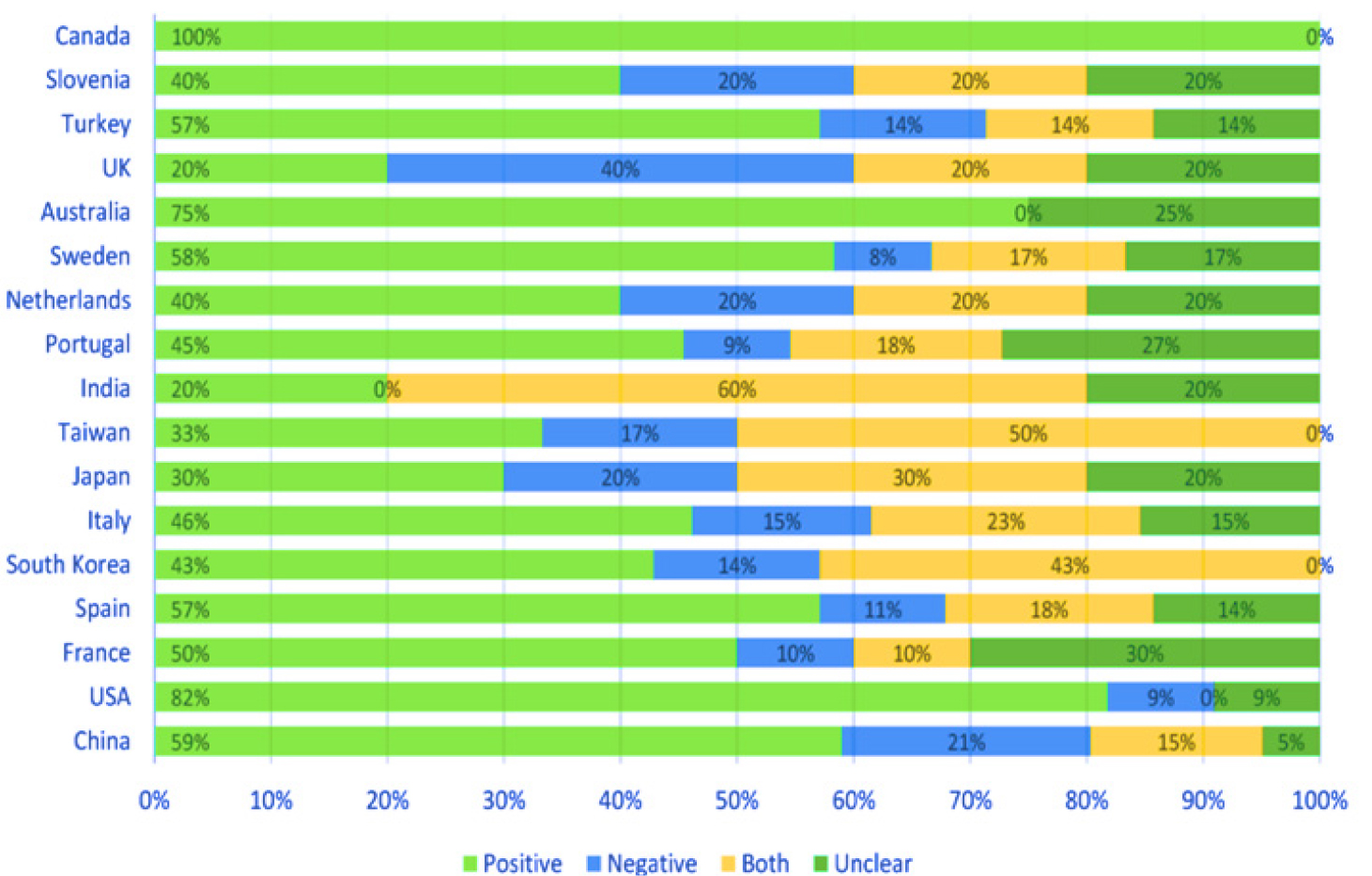
Review of the previous literature review (Momenitabar et al., 2021) on location-based sentiment analysis on the percentage of articles by location and sentiments reveals a predominantly positive sentiment towards HSR in South Korea (Figure 4). The review of the literature did not note any parallel directions of development. Since the change in all the mid and small cities is not unidirectional, there are various local factors which have played a role in the city changes, such as distance, local industry and distance from the capital city, Seoul. Moreover, the threat to micro-level spatial cohesion at the station-area level, and HSR development disrupts the local urban fabric and social structures (Gong and Li, 2022). Shortcomings have been observed due to the proximity of the central business district to the station and city centres in mid and small cities (Kim et al., 2018). There has been a huge difference in the accessibility of the KTX station, which has influenced the number of commuters choosing KTX. However, it has positively impacted the service industry, but hasn’t had a major impact on the industry-based cities. The economic impacts of KTX are not uniform, depending on a complex interplay of factors and local conditions.
While it potentially catalyses economic development, it should be seen as part of a broader development strategy rather than a guaranteed driver of growth. Therefore, strategic recommendations to promote urban development emphasise the need for continued research and careful evaluation of HSR projects, considering both potential benefits and costs. Also, focusing on encouraging public transportation use, building an integrated transportation system, revitalising the surrounding commercial area, and developing a comprehensive urban development strategy has been the most suggested in the studies. Moreover, it has been noted that identifying and establishing causal relationships between HSR and economic changes is difficult due to potential reverse causality and other confounding factors. Also, there are challenges in distinguishing between wealth creation and wealth redistribution (Koh and Yang, 2017). Thus, the changes which have been observed are intensely co-dependent and make it hard to analyse the true impact of the KTX alone on the cities before and after opening. One of the studies uses the DID model, which fails to capture the constant change due to KTX due to its time constraints (He and Jin, 2024). Therefore, time-varying models are required in order to capture the socio- economic changes over a longer temporal scale.
Additionally, it has also been observed that there is a lack of research on LULC change in the cities, excluding the station periphery changes. Besides, the flow of population after the opening of KTX lines and the direction of the influx of population have not been analysed; however, it has its limitations due to the overall decreasing population.
Moreover, from a broader research perspective, there is still a need to explore the comparative analysis at the international and local scales. Where the key driver of relational factors needs to be studied at various levels, but at a larger temporal scale, such as behavioural, Industrial scale and corporate scale shift. This review suggests that since studies are mostly very much focused on the positive findings, macro disadvantages have not been fully covered and are yet to be explored throughout the region. Also, the micro-level studies focused on the trade-offs due to the HSR are needed.
Moreover, there is a need to study the long-term shift due to the HSR in shifting the growth to what level through area-specific curated modals.
A significant challenge in synthesising the existing research is the methodological heterogeneity due to various local factors considered in the study as factors at various spatial scales. Studies based on regression models need to establish robust causal links. Some studies miss long-term development or adaptation effects due to the shorter temporal range of the study. Such as the analytical approach using five years of data.
Behavioural consciousness survey- study limits itself to station-centric vision, and couldn’t capture the behaviour shift due to reliability on a short period of temporal data. Highlighting potential bias and selection bias since city connectivity can differ due to previous decisions which has not been taken as a factor in the existing literature.
Moreover, secondary data, smartphone dependency can result in constraints. The observation window is very small and relies heavily on secondary data (Jeong, 2015). Furthermore, the correlation between urbanisation and development due to HSR is hard to find due to its heavy correlation with each other and other factors or local factors.
While single-city analysis or measuring metropolitan cities provided meaningful insights (Kim and Kim, 2016). However, from a broader research perspective on HSR, a more comprehensive understanding is required by expanding the analysis across multiple cities at a larger temporal scale, alongside using eigenvector centrality as a main factor in order to strengthen relational factors.
V. Conclusion
This paper evaluates the degree of impact, contradiction and shortcomings, and specifically highlights the key points that have not been fully addressed. Results are dependent on the assumption, specification, and model choices for understanding the true impact of HSR on cities. This study tried to capture the changes due to KTX alongside the international scenarios. Most of the studies are specific to a particular region, where rural or mid-sized cities have not been covered (Zheng and Rho, 2015), which limits the study.
A limitation of the study is that it still fails to fully capture the dynamic evolution of the network over time and its long-term impact on various parameters through the existing literature. Since city and station-level studies mask out the interregional inequalities.
This study attempts to provide a consolidated view of the role and development of high-speed rail in Korea, with a particular focus on socioeconomic impact derived from the comprehensive analysis of literature. In summary, while HSRs can potentially encourage regional development and improve connectivity, their socio- economic impacts are contingent upon existing local conditions and supportive policies. Therefore, recommendations for future research are, first, to prioritise capturing the complex, multi-scalar, and long-term/ multi-decade impact of HSR using large-scale temporal data and multi-city analysis. Whereas multi-method approaches, which control for confounders and for comparative analysis, require careful attention for counterfactual construction and exogenous shock. These studies need a robustness check and need to include multiple parameters, since the cause of the relationship in such studies is hard to find through homogeneous data.
Second, Studies particularly focused on the creation of new economics rather than wealth distribution are essential.
Third, there is an added necessity for systematic meta-analysis of cross-national studies yet to be explored for a more comprehensive understanding.
Finally, Econometric models are indispensable for both causal inference and simulation and policy models, such as New Geographic Economics Models and Computable General Equilibrium models, while using these needs to consider their inherent limitations.